

Product Info
The Turbomotive was an experimental steam locomotive built in 1935 by the London, Midland, and Scottish Railway (LMS) under the direction of Chief Mechanical Engineer William Stanier. Based on the successful Princess Royal Class design, the Turbomotive stood out for its use of a steam turbine instead of traditional reciprocating pistons.
This turbine arrangement allowed for smoother, quieter running, and fewer mechanical parts, which theoretically meant reduced maintenance and greater reliability at sustained high speeds. It was especially efficient on long-distance, high-speed runs where constant power was required.
However, the lack of a reliable reverse gear and reduced flexibility at lower speeds or for shunting limited its practical application. Despite promising performance, the complexities of turbine technology in rail use led to the project being discontinued. After World War II, in 1949, the Turbomotive was rebuilt as a conventional piston-driven locomotive, marking the end of Britain’s brief experiment with steam turbine propulsion in railways.
Specific to R30398:
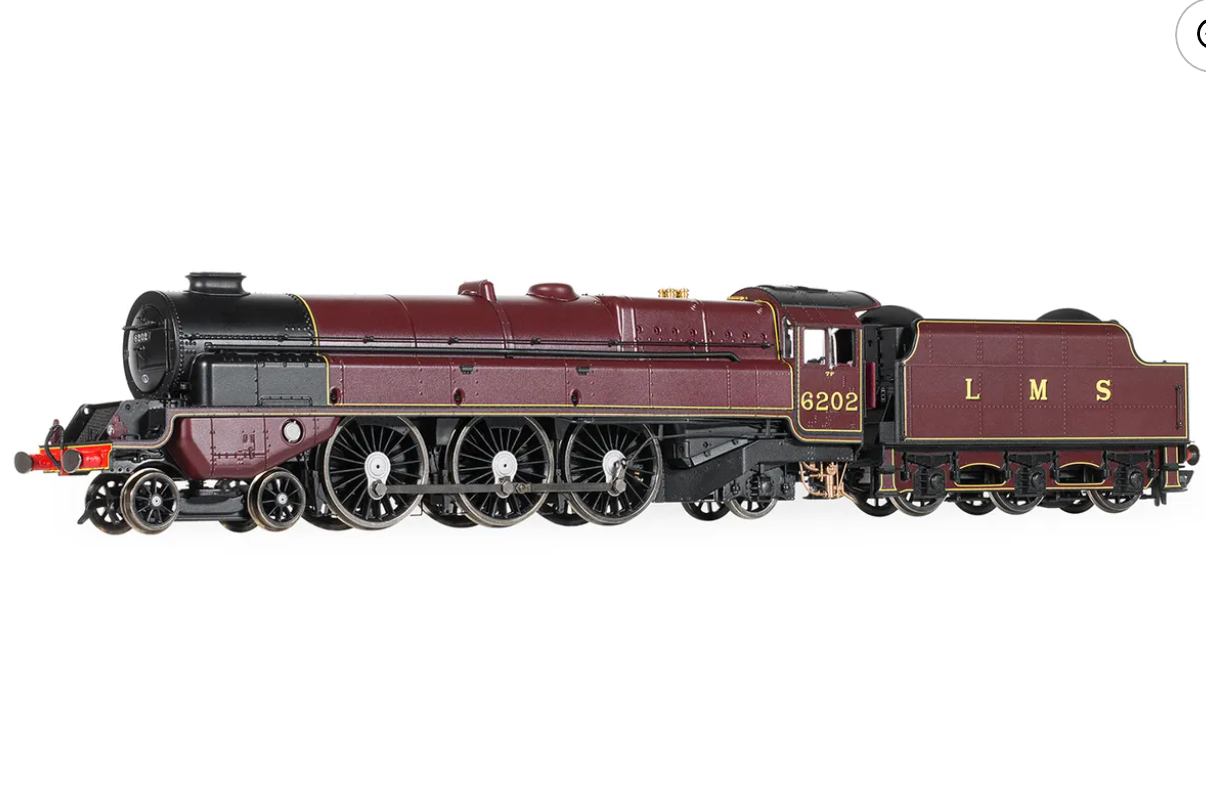
Replacement 40 superheater boiler with regulator housed in separate dome
4000 Gallon standard pattern Stanier Tender with roller bearings
Reverse Turbine modifications added
Model represents condition post 1936 modifications
LMS Lake livery
Separately fitted nameplate, number plate and company ownership plate
Princess Royal ‘Turbomotive’ Features:
High detail OO gauge model based on extensive research and original works drawings
Working headlamps with the option to fit standard lamp brackets
Tender lamp operation controlled by touch
21 pin DCC socket in the locomotive
Fully compatible with Hornby HM7000 control system with a meticulously crafted ‘Turbomotive’ sound available for download
High detail cab and fully decorated backhead with decorated instrument dials
Fully decorated bespoke cab crew supplied
Fully adjustable oil cooler radiator flap
Powerful 5-pole skew wound motor
Flywheel with cardan shaft arrangement for smooth running
Pogo pin wheel pickup arrangement for easy pickup servicing
Heavy diecast chassis, pony truck and trailing truck
Very heavy diecast body
Oilite main drive bearings
Opening cab roof vent
Sprung metal buffers
Rear NEM coupling pocket, detailed front bogie
Optional fit rear flanged wheelset. Only recommended for larger layouts with sweeping curves or for display purposes
Wheel pickups on the main locomotive and tender wheelsets
Separately fitted simulated coal load
